

Most creators burn out from constantly starting from zero, but the smartest ones understand that one well-crafted piece can become 10+ different assets using the right multiplication strategy. It’s time to build a content engine that compounds your impact while cutting your workload in half.
Working Smarter Strategy
Smart creators don’t create more content; they make their best content work 10x harder across multiple platforms and formats.
Psychology-Backed Multiplication
One well-crafted article can become 10+ assets using psychology-backed repurposing strategies that compound your expertise.
Escaping Content Burnout
Stop the content hamster wheel: transform your best-performing pieces into systematic content engines that scale without burnout.
Multiplication Beats Creation
Content multiplication beats content creation. Leverage mere exposure psychology to turn one insight into months of strategic assets.
So many content creators go through the same thing: When Monday morning hits, the panic sets in. “What am I going to post this week? What newsletter topics will resonate? How do I fill that editorial calendar that seems to mock me with its endless empty boxes?”
It’s a common phenomenon these days. There’s an endless need to create more content.
But the constant pressure to produce fresh material burns out content creators faster than almost anything else. You must be doing something wrong if you constantly feel burnt out. What if there’s a different solution?
Think for a moment about your most successful piece of content in the past year. The one that generated the most engagement, sparked the most meaningful conversations, and positioned you as a thought leader in your space. It’s the one that’s got you questioning how you can repeat that brilliance.
What if you could turn that one-hit wonder into a well-performing week of content?
The issue isn’t that you need more ideas; it’s that you’re throwing away your best ones after using them once.
The Neuroscience Behind Content Multiplication
Repurposing content the right way taps into fundamental patterns of how our brains process and remember information. In short, if you’re doing it right, you and your audience will remember your content far longer than the people who only produce singular great content pieces.
But there’s actually something much deeper to content repurposing than what we see on the surface level. We receive a dopamine hit every time we encounter something familiar. This neurotransmitter is deeply involved in reinforcement, a trait commonly connected to addiction. We’re chemically adapted to get a “feel good” dose of chemicals every time we recognize something familiar in a learning environment, too.
When you produce similar content, your audience starts to associate your words with your brand. And your audience needs multiple encounters to make sure that the core insights you produce truly resonate.
Now imagine how effective it is when you’re constantly exposed to the same message?
It’s now become common knowledge that content marketing takes time. When we start to repeat the same message, even without positive results, it becomes ingrained in a common audience. Even though it takes, on average, three to six months for traffic to change noticeably because of the content that you’re producing, you’ll start to see a significant, genuine audience start to form related to your specific brand.
Think about some news journalists you’ve come to trust. They produce content that seems reliable and makes sense to you. They stay true to their message, and you become more convinced of their reliability.
Without even realizing it, your brain is creating neural pathways connected to that information. It’s setting up a structure of trust that makes it easy for your audience to engage with you. And the more you engage your audience with different kinds of content—including video, graphics, and writing—the more likely it is to sink in.

The Content Multiplication Solution
But the answer isn’t creating more content. It’s creating content systems that scale your expertise without scaling your stress.
Think about how your own content consumption habits work. You might see a concept mentioned in a newsletter, encounter it again on LinkedIn, then finally understand its full implications when you hear the creator discuss it in a long podcast. That’s not a coincidence. Exposure and elaborate processing work together to deepen your understanding.
The content creators who can keep the ball rolling operate like film studios. Disney doesn’t create one character and move on. They’ve turned Mickey Mouse into movies, theme parks, merchandise, and streaming content. There’s a reason why you see that mouse everywhere. Each format serves the same core brand while reaching different audiences and serving different consumption preferences.
Your expertise should get the same approach.
Content multiplication works because it aligns both psychology and modern media consumption patterns. Your audience doesn’t live on a single platform. They scroll through LinkedIn on coffee breaks, listen to podcasts during commutes, and read newsletters in quiet moments. If you’re presenting your insights across these different contexts, you’re not being repetitive. You’re being thorough.
So, your strategy shifts from “What should I create?” to “How can I explore this insight from every angle?”
Your 10-Point Content Multiplication System
Chances are you’re already using a variant form of content multiplication. So, to make it much easier, let’s break it down into a systematic approach for transforming one well-crafted article into multiple high-value assets:
1. The Foundation Audit
At this point, it shouldn’t exactly be surprising that we’re starting with an audit. It gives you the best idea of which content has performed the best in the past year.
Look for pieces that have generated strong engagement, sparked conversations, or positioned you as a thought leader. The concepts you’ve already presented are a gold mine of value, and chances are you can increase your reach dramatically by reformatting them.
2. The Core Massage Extraction
Identify three to five key insights from your source content. What are the breakthrough concepts that made each piece successful? Message extraction makes it easy for you to effectively plan successful writing strategies. And it keeps your message simple.
3. The Format Matrix
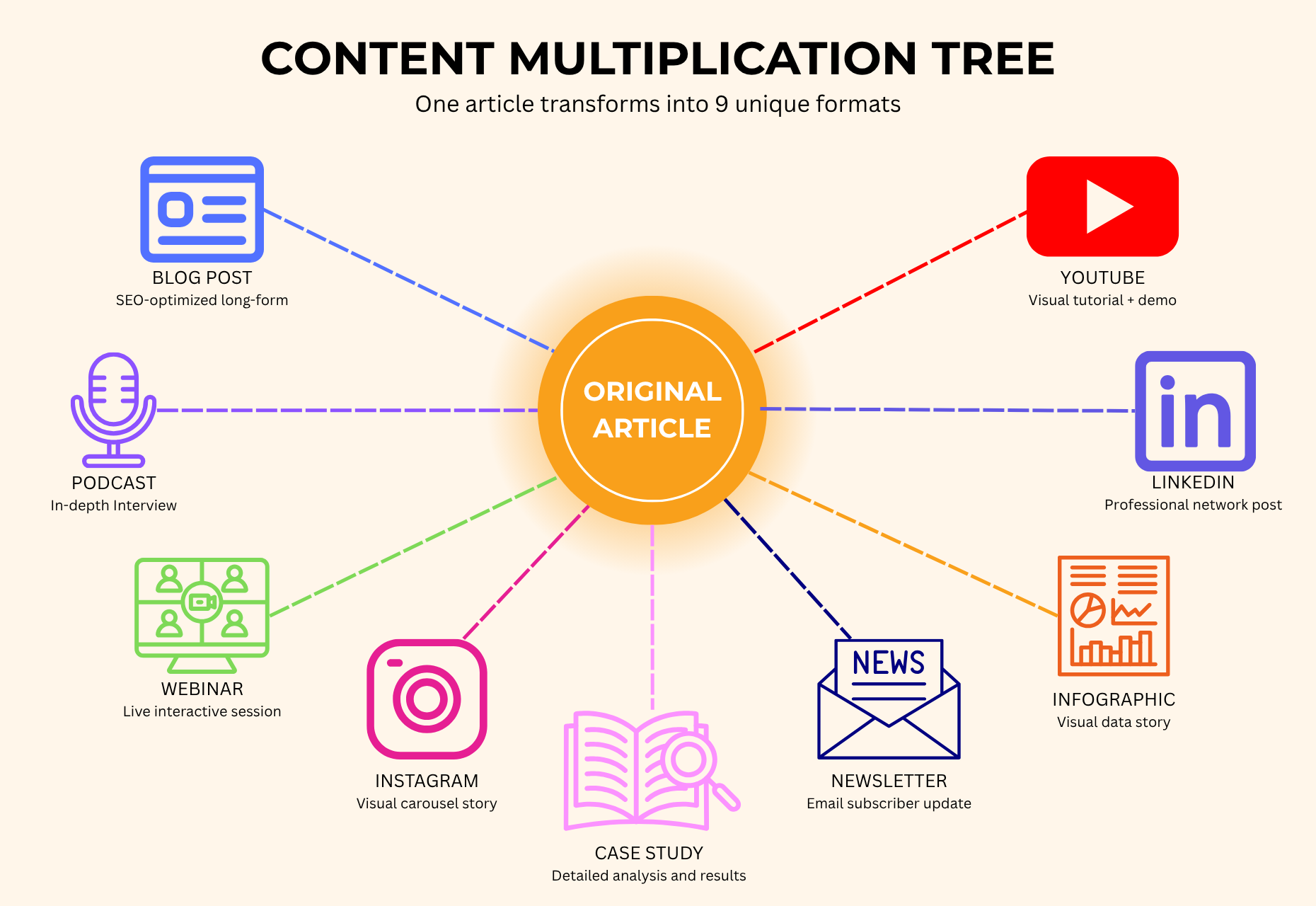
When you find the key message, map each core insight to different content formats. A single message could be the foundation for a LinkedIn carousel, a newsletter deep dive, a video tutorial, a podcast interview topic, and even a case study.
Your goal is to serve different learning styles and consumption preferences. Creating different versions of the same content means you’ll reach more people while staying true to your brand.
4. The Platform Strategy
Align your formats with each platform’s unique strengths. For example, LinkedIn favors professional insights and visual frameworks. Newsletters allow for deeper exploration and personal storytelling. Videos are great at demonstrating processes and building personal connections.
Also, consider that you may feel more comfortable in different formats. In a newsletter setting, you’re much more open, and you can advertise that vulnerability on LinkedIn. Meanwhile, you can push for more people to listen to your podcast, where you’ll engage with people who can share greater insights than you could.
5. The Time Expansion Method
Turn one concept into a content series. When you post something on LinkedIn, you’ve usually only scratched the surface. Break a detailed guide into weekly newsletter installments. Turn a case study into a multi-part LinkedIn series.
When you build your content calendar around systematic message reinforcement, your message gains more weight. It’s much easier to convert audiences when you are guiding them through systematic processes.
6. The Perspective Shift
Unique perspectives are usually the most effective when they’re presented from different angles. So, share a business case in one piece, the implementation steps in another, and the common mistakes in a third.
Often, your audience needs multiple entry points to fully grasp a concept. Even though your brand may be easy to understand for you, it’s likely that your audience still struggles with the intricacies because of their different backgrounds.
7. The Social Proof Integration
Transform your client results and case studies into multiple assets. For example, the same client success can become a LinkedIn post highlighting the outcome, a newsletter exploring the strategy, and a video walkthrough of the implementation process.
8. The Question-Based Expansion
One of the most valuable assets you have is the perspectives of others. You may not even have considered the problems that are so readily prevalent in someone else’s life. So, use those audience questions and comments to guide your repurposing.
Every piece of content you produce should be repurposed directly for your audience’s needs. If your original article sparked specific questions, create follow-up content that addresses those concerns.
9. The Update and Refresh Strategy
Your content shouldn’t have a stopping point simply because you’re done talking about it. New questions arise, new problems form, and new perspectives are always worth discussing.
Revisit successful content with new data, updated examples, or fresh perspectives. Your e-mail marketing, for instance, will continue to deliver impressive ROI as your strategies evolve. The new information gives you natural opportunities to update and republish proven frameworks.
10. The Cross-Pollination Technique
Once you’ve found a strategy that works for one platform, share it across the others. Combine insights from multiple successful pieces to create new perspectives. New takes on old ideas multiply your content without making you dig deeply into new topics.
Implementing Your 30-Day Content Multiplication Sprint
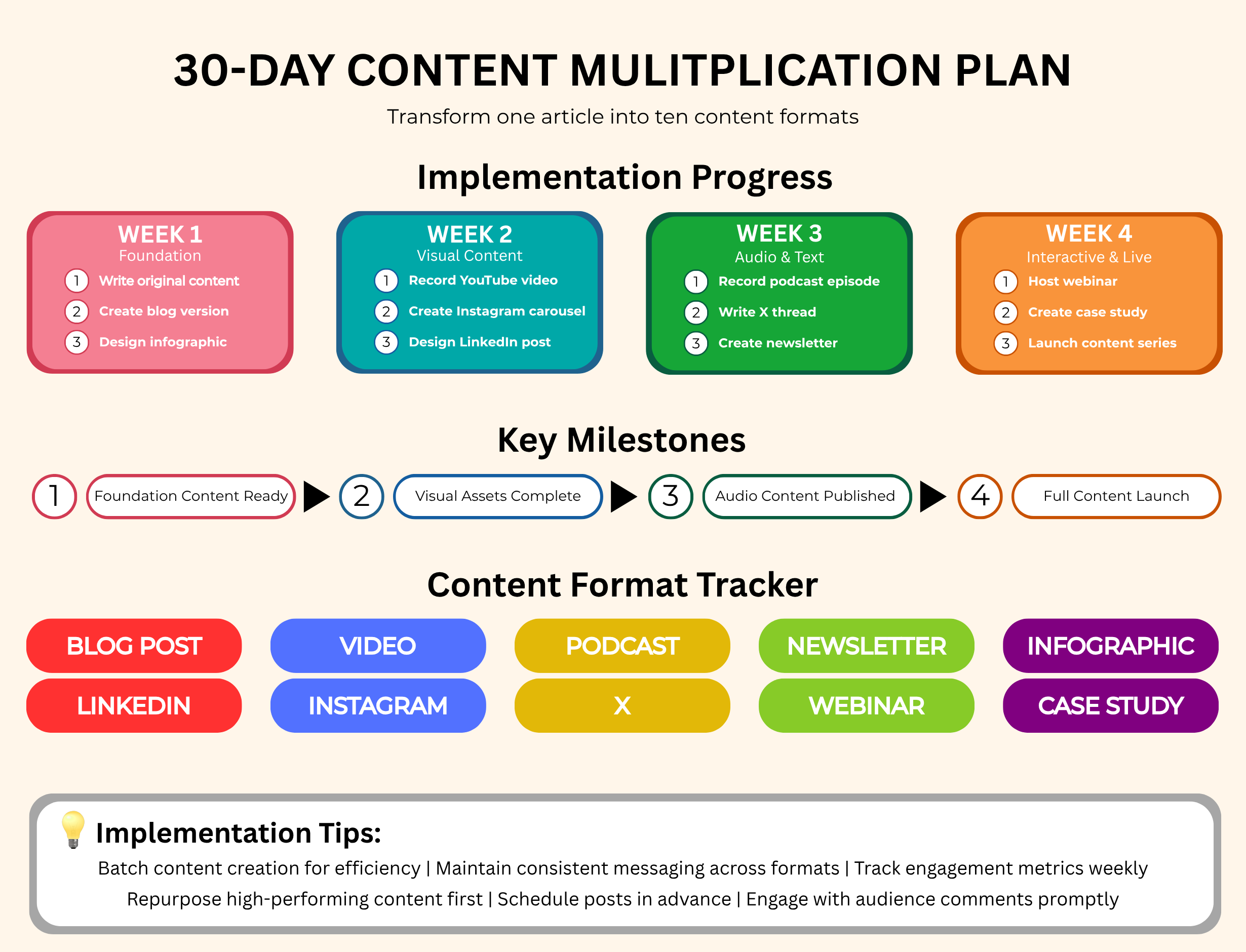
The biggest mistake you can make when implementing your multiplication strategy is to make it too difficult. That’s why I’ve created a 30-day content multiplication sprint you can easily put into effect:
Week 1: Foundation and Analysis
Think of this as your content archaeology expedition. You’re conducting a comprehensive audit to identify pieces that sparked meaningful conversations and positioned yourself as a thought leader. In some cases, your most valuable content isn’t your most liked post. Sometimes it’s the one that led to two or three new client inquiries.
This week, focus on extracting the core insights that will empower your multiplication strategy and create a strategic road map for expansion across channels.
- Audit your content from the past 12 months
- Identify your top three best-performing pieces
- Extract 3 to 5 core insights from each piece
- Create a multiplication matrix, mapping insights to formats
Week 2: Quick Wins and Social Assets
This week marks the start of your momentum with high-impact, low-effort content assets. You want to transform your insights into fresh, valuable content that feels authentic instead of recycled.
Focus on specific cases, common mistakes, and implementation tips that serve different audience segments. Hammer home your key messages across multiple touchpoints and platforms.
- Key insights into 5 LinkedIn posts
- Create 3 newsletters from your frameworks
- Design two visual quotes or infographics
- Write one article focusing on a single insight
Week 3: Deep Dive Content
In your third week, you’re focusing on higher-value, longer-form content that establishes authority. Focus on substantial assets that provide social proof, demonstrate practical application, and position you as both a thought leader and a practical problem solver.
Believe it or not, these pieces will often become your highest-performing content because they offer genuine utility beyond the surface-level insights.
- Develop one case study from client results mentioned in original content
- Create one video explaining a complex concept from your article
- Write 1 detailed how-to guide on implementation steps
- Design 1 downloadable framework or checklist
Week 4: Cross-Platform Integration
For your final week, build systems that extend your content’s lifespan and deepen authentic relationships. In your final phase, you’re focused on creating content that works across different platforms and consumption contexts, including e-mail series that build anticipation to presentation formats that create interactive experiences.
You want your content to continue to gain speed long after its inception. So, think of this part as an extension of your 30-day sprint.
- Develop 1 e-mail series based on your core framework
- Create 1 podcast episode outline discussing your insights
- Write one guest post for another publication using your frameworks
- Plan 1 webinar or presentation based on your content themes
Make Your Content Multiplication Effortless
Let’s get down to brass tacks: Implementing content multiplication requires consistent strategic thinking and significant time. Most entrepreneurs simply don’t have that time.
Professional ghostwriting services transform your content approach from a time-consuming obligation to a systematic multiplication engine. Create smarter content systems that don’t rely solely on creating more content.
The Complete Content Multiplication Solution:
- Book Ghostwriting: Your manuscript becomes a content goldmine, with each chapter spawning articles, newsletters, and social campaigns
- Article Ghostwriting: Strategic pieces designed with multiplication in mind—multiple angles, quotable frameworks, and cross-platform potential built in
- Newsletter Ghostwriting: High-ROI email marketing that transforms your expertise into systematic relationship-building
- LinkedIn Ghostwriting: Consistent thought leadership presence that builds authority without consuming your day
An experienced ghostwriter sees multiplication opportunities that you’ll likely miss. They understand how one client study becomes a LinkedIn post, a newsletter lesson, and a book chapter. In short, they can transform your speaking points into content assets that will work across different audience segments.
But, perhaps best of all, they free you to focus on building your business while ensuring your expertise reaches its full potential across every channel.
Your expertise has proven its value. Now it’s time to make it work as hard as you do.
Ready to transform your content approach from content creation to strategic multiplication? Contact me today to see how professional ghostwriting services can help you build the content systems that scale your expertise without scaling your stress.