
Social media isn’t winning. Email newsletters still dominate with a massive 36:1 ROI. You own your subscriber list completely – no algorithms, no landlords. That direct connection means higher conversions, deeper relationships, and more sales in your pocket.
Own Your Audience
Your e-mail list belongs to you, not tech billionaires who change algorithms on a whim. Nothing can stand between you and your audience.
Audience = Conversion
Newsletters give you a 4-5 minute focused attention span that can deliver an ROI of $36 for every $1 spent.
Trust Through Intimacy
Newsletters create a one-to-one conversion that drives genuine relationships. Personal connection means deeper content and trust.
Short-form video content is the future, right?
Creators providing free content in long- and short-form videos have even worried film executives. Free-to-film sixty-second videos can generate more views than a TV series that costs hundreds of millions of dollars to create.
But likes and views don’t necessarily translate to conversions.
Newsletter marketing is still the most efficient way to drive conversions. E-mail still dominates the digital marketing realm.
In fact, the ROI isn’t even close. Litmus research has shown that e-mail marketing consistently delivers an ROI of $36 for every $1 spent. By comparison, LinkedIn, the medium known for generating business leads, only generates an average of $2.26 per $1 spent.
It turns out that whispers you’ve heard that “E-mail is dead” are wrong.
Dead wrong.
Let’s break it down.

Owning Your Profit
We’ve seen it time and time again: social media changes the algorithms. One minute, you’re getting tens of thousands of organic impressions, and the next, you’re struggling to remain relevant.
That’s because, whenever you build a following, you’re at the mercy of whoever owns the social media platform. Mark Zuckerberg, Bill Gates, and Elon Musk delegate how much you earn on a forever-shifting algorithmic basis.
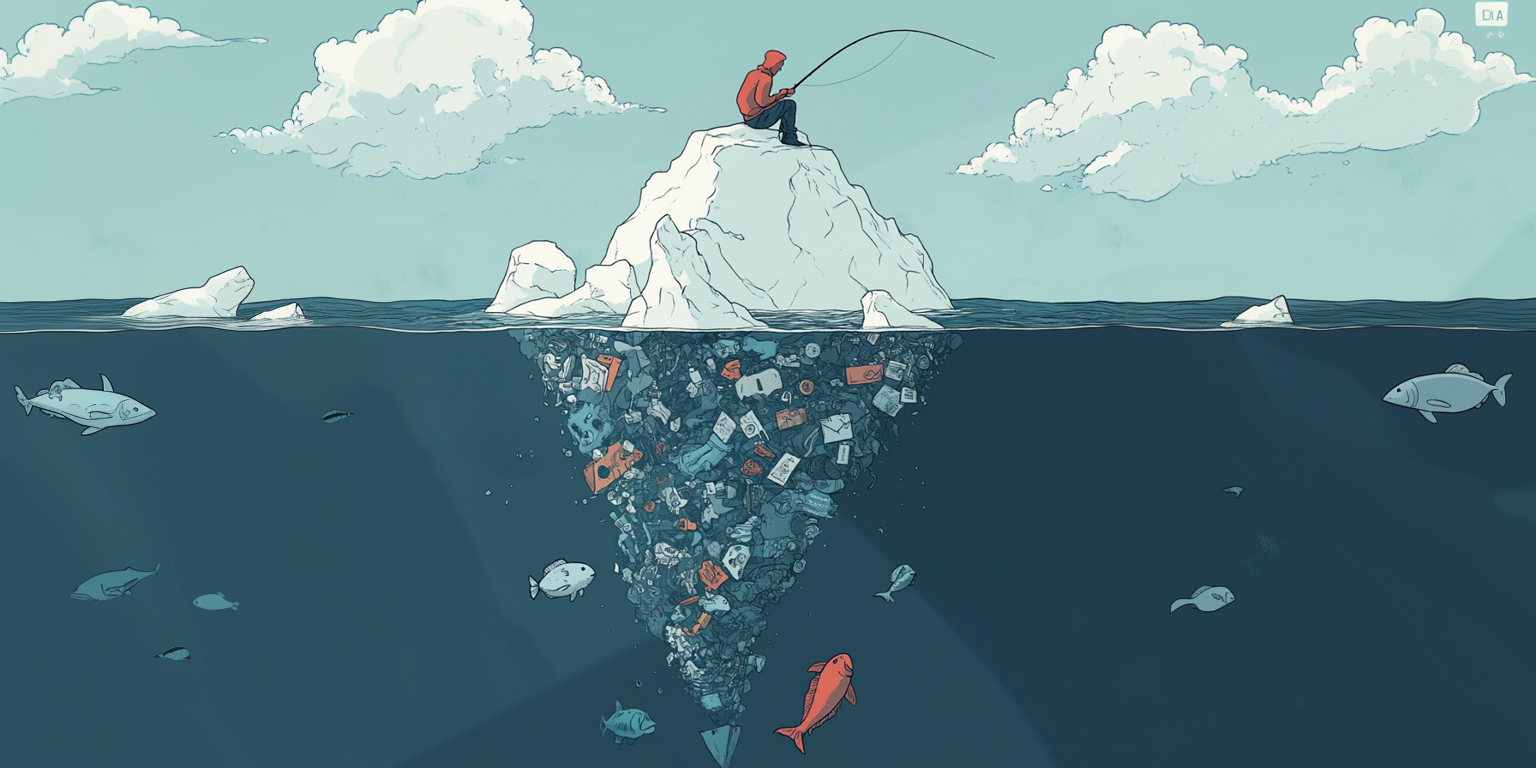
When you build a following on Instagram, Facebook, or LinkedIn, you’re essentially building your house on rented land.
What happens when the landlord changes the rules? (And they always do.)
The cold, hard fact: You don’t own your social media audience.
Your e-mail list? That’s different. You own it. Completely.
No algorithm can take it away. No platform can charge you to reach the people who choose to learn from you. No one stands between you and your audience.
Generating Attention
Social media is entirely devoted to in-the-moment viewing. Very rarely do people return to videos or posts. They’re meant to create a dopamine hit.
But e-mail demands a different kind of attention.
When someone opens your newsletter, you have their focused attention in a way that’s nearly impossible to achieve on social platforms. There’s no competing content immediately visible. No notifications pulling them away. Just your words and their eyes.
Most social media content is consumed within a few seconds, while a newsletter typically takes 4 to 5 minutes to read when the consumer has opted in.
That difference is astronomical in a society with a low attention span.
Farming for engagement on social media ultimately means less impact. But a newsletter encouraging readers to continue interacting with you or “Buy Now” is significantly more engaging.
Turning Intimacy Into Your Secret Weapon
Nothing feels more welcoming than service tailored directly to you. You’re receiving the messages you signed up for. You’re engaging with content and people you want to see.
Social media takes away that intimacy.
Something as simple as signing up for a newsletter changes how well your message will be received. It’s a simple psychological distinction, and it works.
When you’re writing on LinkedIn, you’re writing to a crowd. But when you write a newsletter, you’re writing to a specific person. Just one person. It feels like a one-on-one conversation in their inbox.
That kind of intimacy builds trust. Trust builds relationships. Relationships drive sales.
The most successful newsletters leverage this intimacy. A more intimate setting means you’re not just writing marketing copy. You’re writing a letter to a friend.
And you can offer things you wouldn’t on social media.
Converting with Depth
Newsletters are the start of thought leadership.
Think about it this way: On social media, you only have so much time to draw attention. You need quick, snappy concepts that can be filled out in bullet points.
Newsletters allow for deep dives, for nuance, for explanations. They provide the landscape for intellectual discussions and generate true fans, not just casual followers.
Social media’s character limits and fleeting nature make it difficult to dive deep.
As a thought leader in your industry, those complex and nuanced ideas build your brand. But they’re difficult to show in an infographic.
Newsletters help you demonstrate value. They can make subscribers hunger for more than what they can get from the tidbits on social media.
In newsletters, you can sell your point to those in the “in crowd.”
Conversion Mathematics
Anyone can make claims, but the truth is in the numbers.
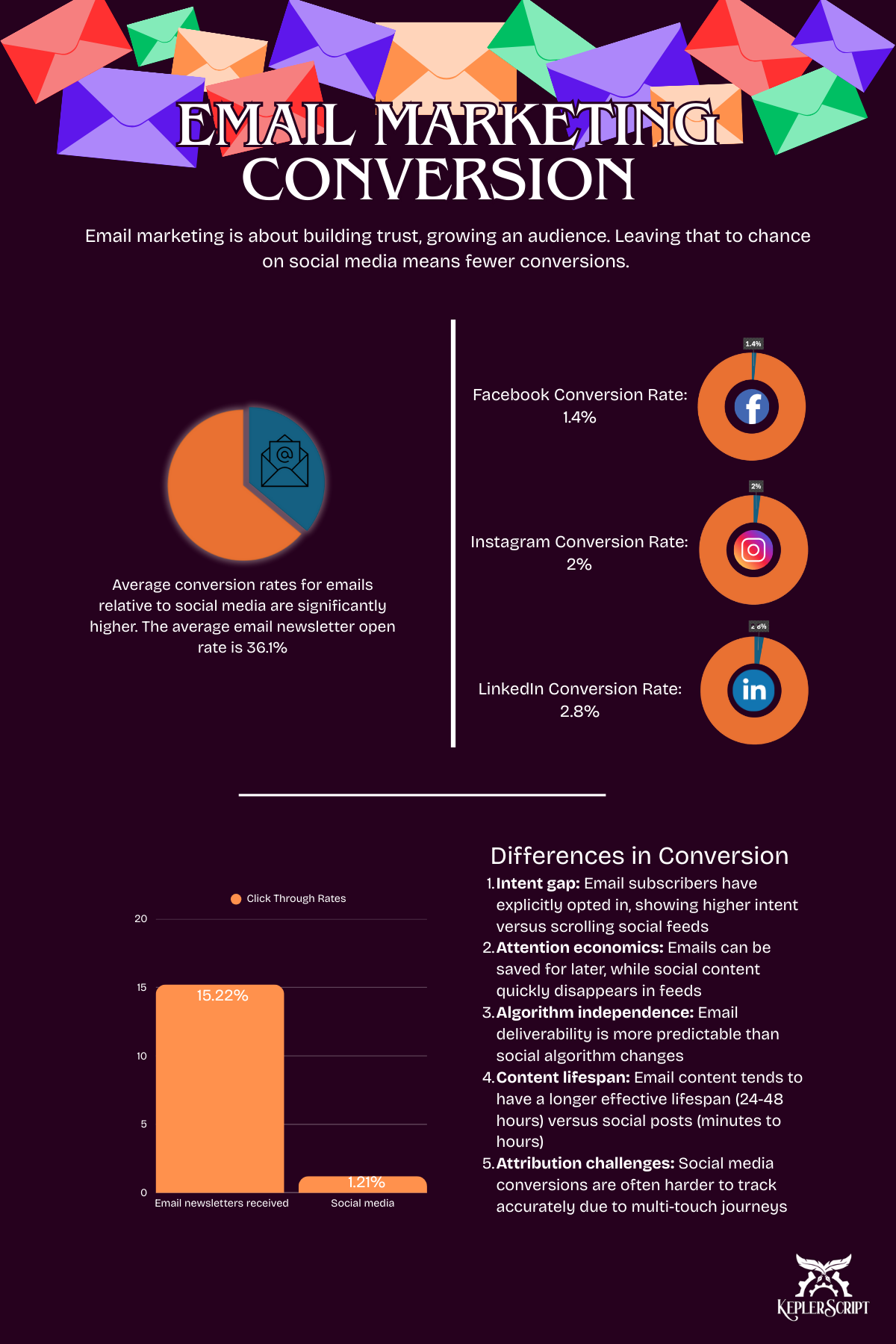
The average e-mail open rate across industries is about 36.1%.
On Facebook, the average engagement rate (likes, comments, shares) is 1.4%. Instagram? Slightly better at 2%. LinkedIn? Around 2.8%.
But engagement isn’t conversion. And conversion is what sells.
When it comes to direct sales click-through rates:
- E-mail newsletters received a 22% click-through rate
- Social media received a 21% click-through rate, on average.
That’s a 12.5x difference in effectiveness.
Those aren’t just statistics. They’re checks.
Precise Segmentation
Segmentation is one of the best features of e-mail that can’t be matched in social media.
Social media platforms are designed to reach a large audience, which usually means a lack of personalization. Marketing for your brand means targeting multiple audiences. Some of the most common segmentations include
- Premium service subscribers versus entry-level offerings
- Different service categories like resulting or implementation
- New subscribers versus longtime followers
- Highly engaged contacts versus dormant prospects
It’s like a personal handshake. You’re tailoring to them so they get the best experience possible.
Creating an Empire
Obviously, your newsletter is important. It gives your audience a chance to hear your voice and what you really think. They’re not distracted by anything else as they sift through what you have to say.
In essence, you have 4 or 5 minutes to make a difference.
But it’s only a piece of the puzzle. Yes, newsletters generate more sales, but using them with other methods gives you the edge.
It’s all about that nuance.
Strategically Integrate, Not Replace
To be clear, I’m not suggesting you abandon social media. Far from it. Ever since social media’s inception, business owners have been using it to create a sales funnel, and rightly so! But it’s just the beginning.
The most effective service marketing strategies use social platforms and e-mail newsletters together, each playing to their own strengths:
- Social Media: Discovery, community building, trend participation, visual storytelling
- E-mail Newsletter: Relationship deepening, direct sales, service launch leverage, long-form value delivery
Instead, start thinking about social media as your battleground for your newsletter. You’re looking to drive sales, which means building trust. The only way customers can trust to use it is if they see the results themselves.
Social media is just the appetizer. The newsletter is where things get more interesting.
The Trust Timeline
Social media creates awareness. E-mail builds trust. Trust drives sales.
Building that trust comes down to the right timeline:
- Build Value First: Provide actionable steps, entertainment, and solutions without asking for anything in return
- Start a Connection: Share your vulnerability by telling personal stories about your ups and downs that led to success
- Capitalize on Credibility: Show your expertise by teaching in simplistic language
- Integrate Social Proof: Share case studies that illustrate the connection you’ve made with others
- Push an Invitation: Make offers that feel more like opportunities than they do sales pitches
Your sales funnel and newsletter messaging provide a cohesive story to engage your prospects. You’re developing a relationship, not just letting your content get lost among the millions of others.
If you do it right, readers will eagerly await the weekly newsletter, and you’ve developed a genuine connection.
Writing with Tech
Once your newsletter starts growing, growth technology becomes imperative. Your message no longer becomes muddled. You have a plan, a system.
And highly impactful conversions in newsletters have some highly technical benefits.
- Testing capabilities: A/B test subject lines, calls to action, and content formats to optimize conversion rates
- Automation sequences: Create “set it and forget it” sequences for new leads or service launches
- Integration with CRMs: Seamlessly connect to your customer data for closed-loop reporting
- Retargeting capabilities: Identify exactly who clicked but didn’t purchase, then follow up precisely
- Lifetime value tracking: Understand which subscribers ultimately become your highest-value clients
Your system turns into crafting a story. It becomes much easier to come up with topics when you have a strategy, plan for success.
And it doesn’t hurt to implement the latest technological advancements.
Overcoming the Time Crunch
The single most difficult problem to overcome is time.
Focusing on your business is already a full-time job. Managing social media is another piece of that puzzle. But writing a consistent, high-quality newsletter? That’s something that takes a significant amount of time.
Let’s be honest: That’s the reason why you haven’t started a newsletter yet. You simply don’t have the bandwidth.
The most successful service providers recognize this problem for what it is: not a task management issue but a delegation opportunity.
By entrusting your newsletter strategy and execution to a ghostwriter who knows your voice and your marketing direction, you get the best of both worlds:
- The high-converting power of a quality newsletter
- The time and mental space to focus on client delivery
It’s not an expense. It’s an investment with that 36:1 return ratio.
The Long Game
Service delivery is becoming increasingly competitive. Great services don’t just deliver great results—they build sustainable business models around their expertise.
At the center of these sustainable models? Almost always, an e-mail newsletter.
Your newsletter isn’t just a marketing channel. It’s a business asset that grows in value over time. An asset you own completely. An asset no platform can take away.
The newsletter advantage isn’t just about better conversion rates today—it’s about creating stability and predictability for your service business for years to come.
And that’s an advantage worth investing in.
Ready to harness the newsletter advantage without sacrificing your client service time? I specialize in crafting high-converting newsletters that sell more services while building your long-term platform. Book a free strategy call to learn how I can help you implement everything in this article without adding to your workload.