

Stop treating your content like random acts of marketing and start building a system that actually drives revenue. A strategic content calendar is the difference between publishing into the void and creating a predictable conversion machine that turns your ideas into measurable business results.
Why You Need a Content Calendar
Transform random content creation into a systematic approach that increases visibility, aligns with business goals, and drives conversions.
Building Your Content Calendar
Use a performance audit, establish content pillars, map appropriate content types across channels, and implement content batching.
Critical Elements for Conversion
Incorporate strategic CTAs tailored to each customer’s journey, organize content, plan systematic repurposing, and schedule reviews.
Implement-ation and Best Practices
Avoid common pitfalls like disconnecting content from sales goals, planning without flexibility, and prioritizing quality over strategy.
If you’re creating content on the fly, you’re bleeding opportunity.
Social media strategists will always tell you that the most important contribution you can make to your business is just to post. To post anything.
The problem is that you can’t create a system of weekly articles, newsletters, and LinkedIn posts that generate results when you’re improvising. Successful businesses generate consistent leads through strategic planning.
Your content isn’t just content. If you use it right, it’s a conversion machine.
The Random Content Trap
See if you recognize this scenario: Monday morning panic becomes the norm. Your team always dreads the inevitable question that kicks off every meeting: “What are we posting today?”
After a while, your team devolves into a ball of stress, forcing you to post content that always seems to start with: “You’re doing it wrong…” Your messaging becomes disconnected across platforms. Your LinkedIn posts contradict your newsletters, which have nothing to do with your blog. Your audience starts to drift away because they can’t keep a handle on what you’re offering.
Your fragmentation ultimately confuses your audience enough that your brand authority stands on shaky ground.
Consistently falling into this method leads to missed opportunities. Your branding topics contradict what you believe. Your competitors start to take over the space you used to dominate.
But this is excruciatingly common. According to the Content Marketing Institute, 58% of B2B marketers think their content is “moderately effective.” Nearly half of those marketers say it’s because they don’t have a clear focus.
It’s an epidemic. Companies don’t have a strategy, so they end up grasping at straws.
The Content Calendar: Your Ultimate Conversion Tool
So, what’s the solution?
It’s really simple: A content calendar. Not leaving your content up to chance is the backbone of an effective marketing strategy. Why? Well, it comes down to a few factors.
1. Random Content to Strategic Campaigns
Creating content based on your business’s objectives means every word you publish works harder for your brand. Your content becomes a visual map of a cohesive story. Creating that content funnel moves your prospects through it without extensive personalized content.
What does that mean for you? You’ll start to see a shift in your sales. Content marketing is the primary source of website traffic, generating 3x more leads than traditional outbound marketing and costing an average of 62% less.
Increased strategic campaigns can be even more successful.
2. Business Goals Align with Content
Even brilliant ad campaigns can fail if you don’t create content that explains why your product is top of the line. Your calendar acts as the bridge between that creative content and your commercial results.
A successful content strategy complements your business goals. Want to emphasize your new product? Content marketing becomes your movie trailer, guiding customers to anticipate its release.
Think about it this way: Your content library is the first step in your customer pipeline. It’s the first thing they’ll encounter when getting interested in your brand.
3. Buyer Journey Touchpoints
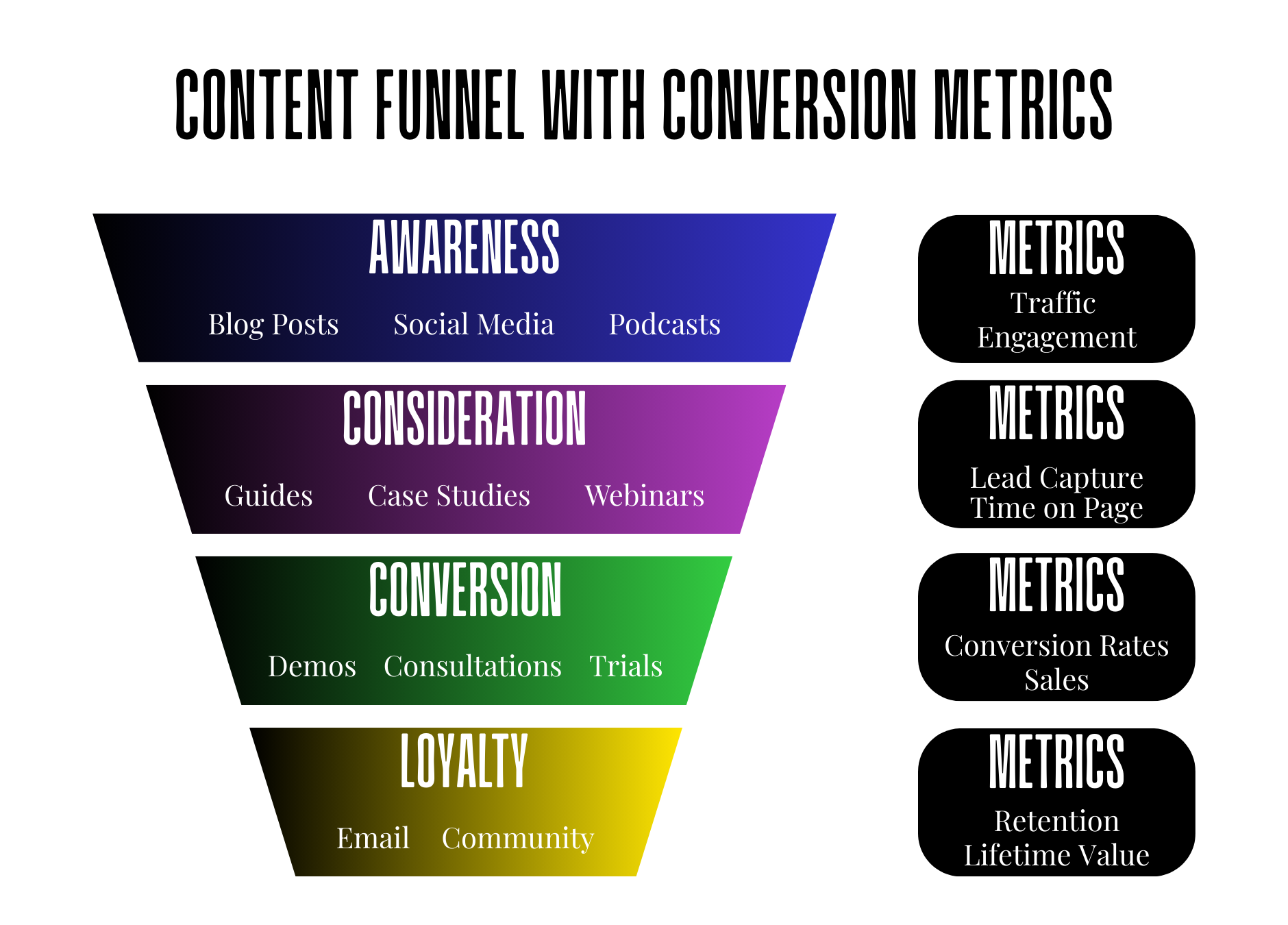
Your calendar should look like a well-traveled map. Smoothly guide them through the awareness, consideration, and decision phases.
- Awareness: Introduce educational content that addresses your customers’ pain points and challenges. Include articles, social media posts, and newsletters addressing these issues. Position yourself as a helpful resource rather than just another vendor.
- Consideration: Guide your customers through solution-driven content unique to your business. Include case studies, comparison guides, and methodology breakdowns to encourage customers to continue evaluating your company as their prime option.
- Decision: Include dates for releasing testimonials, free consultations, and limited-time offers. Your content should create urgency at the last stage.
Mapping a course makes it much easier for customers to navigate your brand.
Building Your Own Conversion-Driven Content Calendar
Theory is all well and good, but the only way to convert is through the tactical implementation of your system. So, how do you build a content calendar that actually drives business results?
Step 1: Audit Current Content Performance
Auditing gives you a reference of where you need to go based on where you’ve been.
- Analyze your content.
Starting from the beginning, analyze where you’ve already been. What has worked before? What hasn’t? Look beyond vanity metrics like “likes” and “shares.” They’re usually not a good indication of conversions anyway.
- Generate the best content formats.
Which content formats are best for your brand? Do your customers enjoy content that is easily accessible, or are they looking for deep dives? (It’s important to note that AI is looking for entirely comprehensive content, so the more detailed you are, the more likely you are to appear in chatbots.)
- Create a channel distribution list.
Determine which distribution channels convert most for your different content types. For example, engaging e-mail newsletters might drive more conversions than social media, or vice versa. The insights you gain from this should reflect in your calendar planning.
Keep in mind that auditing isn’t a one-time exercise. The most effective content calendars are reviewed at least quarterly, if not more often.
Step 2: Define Core Content Pillars
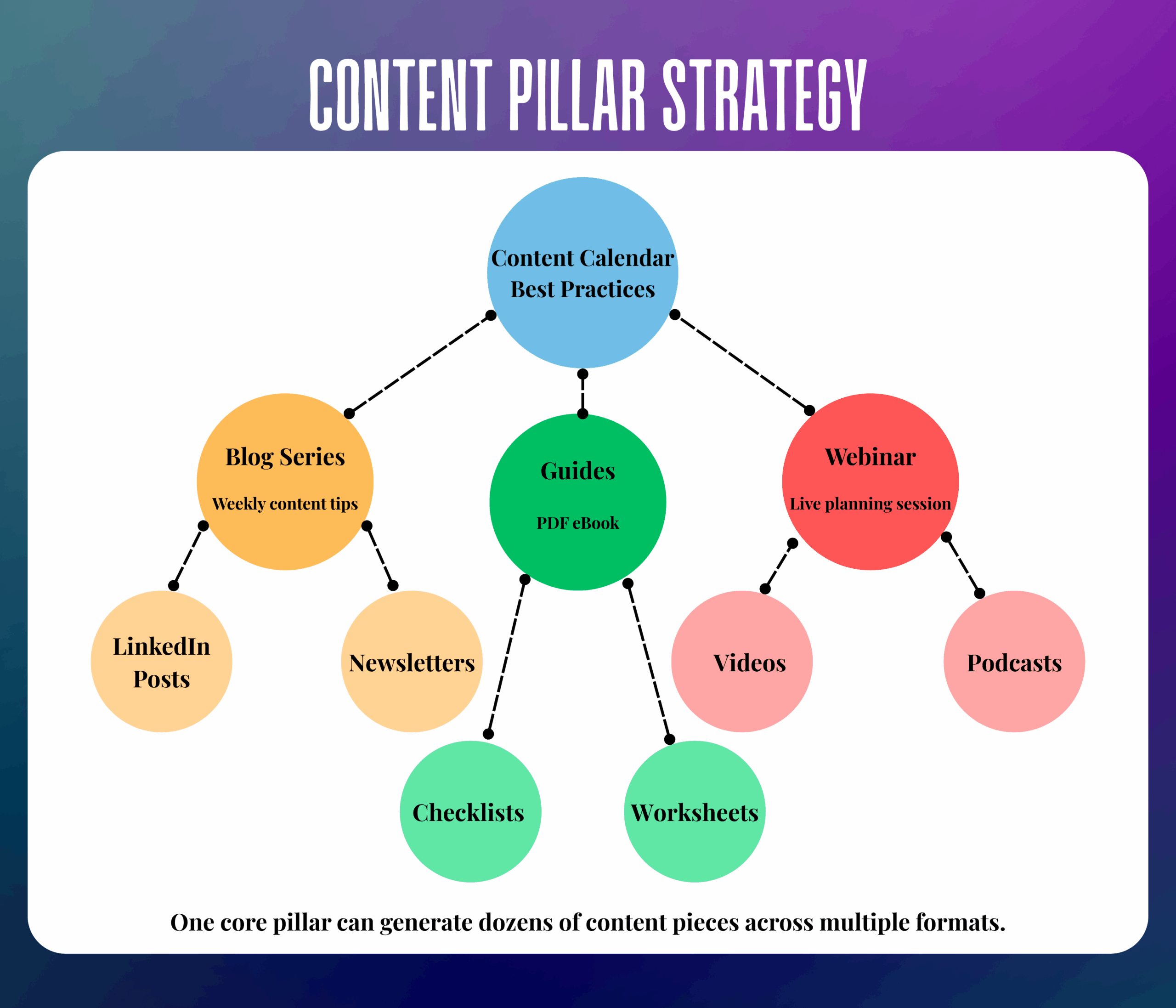
Content pillars are the 3-5 primary topics your brand is known for in your industry. They’re what make your brand what it is. They generate focus and prevent you from taking a more scattered approach.
Separate each of these into visual pillars. Each pillar should directly relate to a key business offering. Any content you create naturally leads to more business opportunities rather than just generating general interest.
Include any customer pain points within those pillars. Explain how you can uniquely solve those problems. The more pain points you enter with lines leading to potential solutions, the more relevance and resonance you’ll have with your target audience.
If you’re a leadership coach, your pillars might include executive presence development, team performance optimization, and strategic decision-making frameworks. Each of these services provides real-world solutions to your clients’ challenges.
Step 3: Map Content Across Channels
It should be no surprise by now that not all content performs equally across every platform. It’s also why generating a calendar without personalized metrics for your business is impossible. Your calendar needs to account for each channel’s unique characteristics and audience expectations.
Next, look at the platform-specific formats that work best. LinkedIn is a great example of a platform with varying formats. Short posts with eye-catching graphics might work better for your company than long-winded text posts. Mix and match those formats with other channels, including adding more in-depth newsletters and linking to engagement-centered articles.
But, perhaps most importantly, remember that different platforms have different conversion potentials. Some channels excel at building awareness but struggle with direct conversion. Include notes in your calendar that reflect these limitations and strengths.
I recommend implementing a 70/20/10 content mix within your calendar to provide the best results. 70% of your content should be educational, valuable content that establishes your expertise and earns your audience’s trust. 20% of your content should include shared content from others with your added insight, which shows you are a curator of industry knowledge. The last 10% is for direct promotional content designed to drive conversions.
It all comes down to a balanced approach. Keep your business objectives top of mind without driving your audience away with over-promotion.
Step 4: Building a Calendar Framework
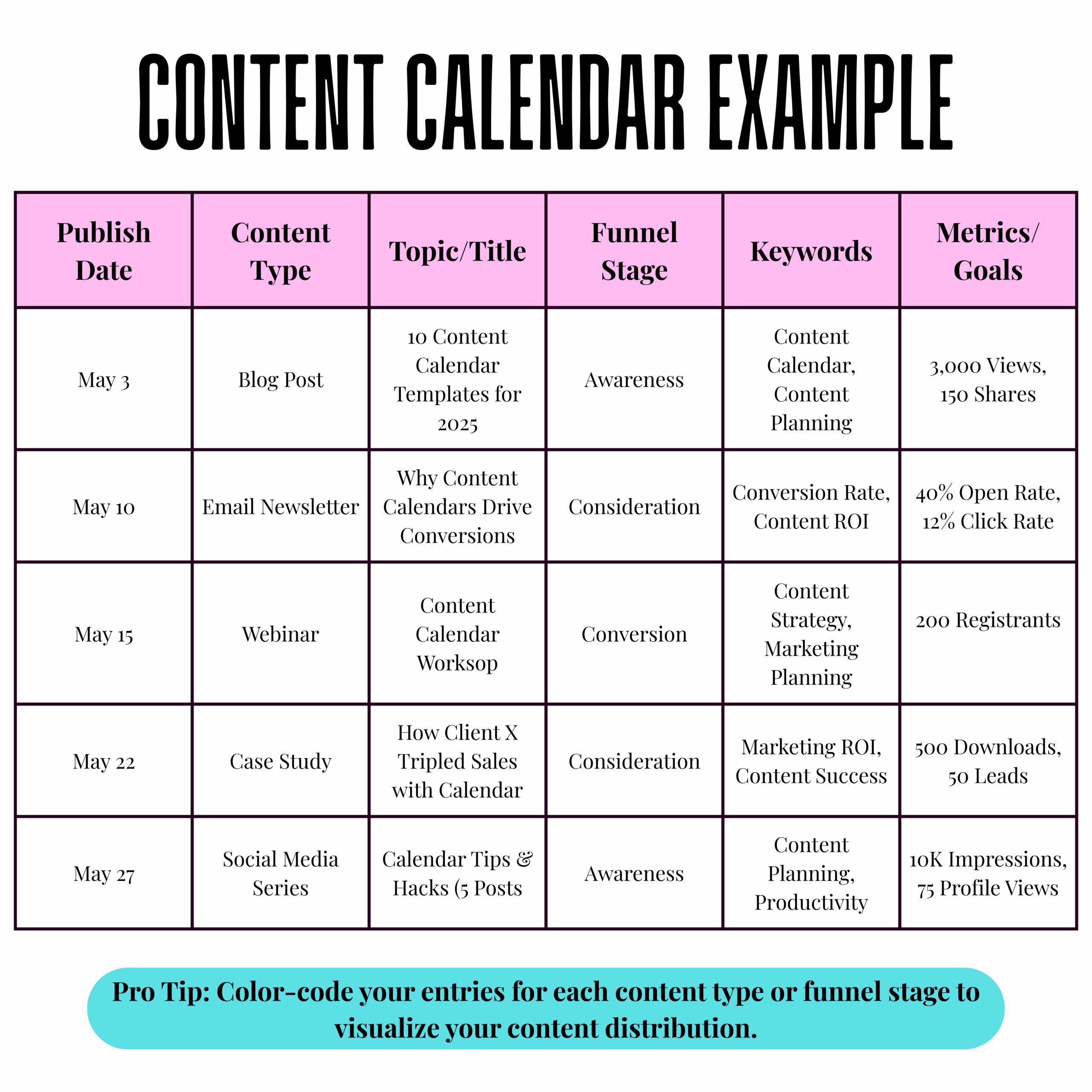
When building your calendar structure, think beyond simple topics and dates. Include different content types and formats for each calendar entry. Consider setting up diverse formats to maintain your audience’s interest.
- Narrow down your audience.
Include a target audience for each piece of content. Don’t try to create content that is one size fits all, which ultimately dilutes relevance and engagement.
- Assign your pillars.
Indicate which content pillar aligns with each entry in your calendar. Check to see if the connection continues. Aim to build cumulative authority in your core areas rather than scattered one-off pieces.
- Establish your prospect’s journey.
Map each piece of content to its appropriate stage in the customer’s journey. Are you creating content for customer awareness, consideration, or decision? Make sure you have balanced coverage across all sales funnels and check up on different departments to make sure you’re on the same page.
- Include a call-to-action.
Encourage your audience to engage with you. Mix up your calls to action to appeal to a wider audience and judge the results.
- Make a tactile calendar.
Once you’re done, put it on a visual calendar. As much fun as it might be to color-code content on a screen, you more clearly see things come together with a more tactile experience. Make sure that each entry bears the load appropriately.
Step 5: Establish a Content Batching System
The most common reason for calendar breakdown isn’t its complexity. It’s a lack of willpower.
So, make your life much easier by creating content batches. You could create something like this:
- Monday: Gather all data, statistics, and resources for the upcoming content
- Tuesday: Write all your content for the next week
- Wednesday: Create all the visuals and format the completed content
- Thursday: Engage with customers to get testimonials and case studies
- Friday: Set up distribution days for scheduling and promoting content across your channels
Humans are creatures of habit, so the more frequently you follow a schedule, the more likely you are to follow through on your calendar.
Just don’t leave it till the last minute.
The Elements that Drive Calendar Conversions
But let’s put your content over the edge. Here are some key strategies to help you increase your conversions.
1. Strategic Calls to Action for Every Piece
Each piece of content’s direct purpose is to drive conversions. So, it only stands to reason that you should ask for the sale after nearly every piece of content you create. In essence, you’re replacing the generic “Contact Us” with sales-driven dialogue.
Action Steps:
- For awareness content, create low-commitment CTAs, like downloadable resources or newsletter subscriptions
- For consideration content, offer mid-commitment CTAs, such as free assessments or webinar registrations
- For decision content, include high-commitment CTAs, like consultation requests or purchase opportunities
- Try out different CTAs at different funnel stages in your calendar; make each of the CTA’s and a natural progression from the conversation before
One of a business’s biggest mistakes is using the same generic CTAs across every medium. Many brands don’t get creative with business strategies. So, to right the ship, intentionally map different CTAs to different funnel stages.
2. Content Funnels That Build Authority
You may have noticed a trend. When it comes to creating content, I’ll continue to harp on the same process: set up a reliable content funnel. The more strategic you are about setting up your authority through laser focus, the more likely your customer will convert. So, what does that look like?
Action Steps:
- Plan comprehensive “pillar” pieces that cover your topics broadly to establish your expertise
- Set up supporting content that explores specific aspects of your products or services in greater detail
- Create internal linking structures to make it easy to navigate between your content
- Assign publication dates for both pillar and supporting content
- Regularly audit and update your pillar content to maintain a fresh perspective
Your goal is to create a content library rather than setting up isolated content islands. It should be easy for your customers to find information on your products or services through a quick search.
3. Repurpose Pathways
Creating a content calendar should extend beyond a week or even a month. You’re mapping how your content transforms across platforms, which means you’re maximizing your investment by being excruciatingly organized. That also includes strategic repurposing.
Action steps:
- For each major piece of content (usually an in-depth article), identify 3-5 ways to repurpose it in the form of newsletters and social media posts
- Schedule funneling structure for each of your repurposed features, highlighting the best time to publish them
- Assign responsibility for repurposing to team members focused on a singular task
- Include platform-specific formatting requirements within your calendar
- Track performance metrics for both original and repurposed content
By spreading your content across a variety of platforms, you’re getting the most out of your content. In essence, you’re creating maximum value for your content investments while maintaining your message’s consistency.
4. Measurement Touchpoints
You can’t improve if you don’t track consistent measurements. So, when creating your calendar, schedule review points to analyze the performance of your content and optimize your approach based on real-world events.
Action Steps:
- Schedule monthly traffic analysis reviews
- Plan quarterly lead generation assessments
- Create semi-annual conversion impact reports
- Assign specific team members to own each measurement touchpoint
Your calendar should become a dynamic, living document. The most effective businesses constantly evolve their strategies, informed by actual business impact.

Your Three-Step Action Plan
There’s a lot that goes into a strategic content calendar. Implementing a strategy that works in the long term can take months to formulate. But, you can take three concrete steps today to vastly improve your results.
Action Step 1: Audit Your Current Content Performance
Find out what works and what doesn’t. Be brutally honest in your assessment, and base your future calendar planning on actual results rather than assumptions. Start today by blocking out two hours and becoming intensely familiar with your content to Ant its performance.
Action Step 2: Define Your 3-5 Core Content Pillars
Explicitly write out your content pillars and map them to your business offerings. Analyze how your content strategically aligns with commercial objectives. You’re not creating your business in a vacuum, so see how you hold up against your competitors.
Action Step 3: Build Your Calendar Framework
Briefly outline your calendar framework using the elements outlined above. You don’t have to develop a comprehensive structure that transforms your content immediately, so take it step by step. See each edition as a creative exercise in your systematic business functions.
Your content calendar isn’t just an organizational tool. Each step is a point along the road map to creating continued revenue growth through content development.
Ready to transform your content from random marketing acts into a strategic business asset? Contact me today to get started. Your content calendar is the difference between hope-based marketing and data-driven results.