

Strategic content funnels guide prospects from awareness to decision through intentionally structured content at each stage of their buying journey. Follow this step-by-step framework for building your own content funnel, including client journey mapping, content auditing, and pathway planning.
Content Funnels
A structured framework guiding potential clients through awareness, consideration, and decision stages using tailored content designed for each step of their journey.
Building Your Funnel
Map your client journey, audit existing content, design clear pathways, and implement connective elements that guide prospects forward.
Professional Advantage
Hiring a professional ghostwriter for your content funnel ensures strategic integration, consistent execution, voice continuity, and data-driven optimization that most businesses can’t achieve alone.
Elevating with a Book
Adding a professionally ghostwritten book creates a powerful authority multiplier that expands your reach, accelerates credibility, generates perpetual leads, and opens doors.
It’s a tale as old as time: You write content, you post it, and it goes nowhere. Clients should be lining up at the door, right?
Sadly, if you’re not seeing results, there’s a reason.
Listen, I used to be the same way. I would post sporadically, focusing mostly on topics I know best: writing. I was told that was the best way to share my business and gain followers. But, when I investigated further, I noticed a missing pattern. And it all came down to a strategic content funnel.
When you’re creating a content funnel correctly, you’re not slapping together a collection of random content pieces. You’re creating a strategic framework that guides your prospects from discovery to a final decision.
Customers having a hard time finding their way through your mess of services?
Not anymore.
What Is a Content Funnel?
A content funnel is a structured journey from your initial offering to the final decision. It organizes your content logically.
Think about it this way: You’re creating a house of content. You’ve already developed the secret passageways and eye-catching elements of the structure. Now, all you need to do is implement it with someone you trust. And you wouldn’t leave your architect alone without the blueprint to build your house.
So why would you leave your customers alone without a guide to purchase your services?
Overcoming Blockades
It’s easy to assign blame to your sales department. If the sales team is just you, that’s especially true. They should know what’s going on, so why aren’t you seeing any results?
But the biggest blockade doesn’t come from stumbling over words in a sales call (most of the time). The disconnection most often occurs while you’re propelling your prospects forward. Customers don’t know what to expect next on the journey. Most content systems also fail to back up their claims along the way.
It quickly descends into chaos.
But what happens when you stop instituting random content creation?
According to the Content Marketing Institute, businesses that engage in content marketing have conversion rates over six times higher than their competitors. In essence, they’re investing time, money, and skill to drive conversions.
With the right strategy, this means that the more content you produce, the more successful your business will be.
Improving Strategic Organization
Many businesses that start from the ground up lack key components for their success. Actually, it’s a fairly common problem: Business leaders don’t have strategic documentation to back up what goes along in their heads.
When the plan goes live, it’s muddied. Processes often involve skipped steps, and you frequently hear the phrase “I forgot to mention…”
Creating a content funnel, on the other hand, forces you to align with your content strategy. You’re taking yourself through the process step by step, making notes about what works and what doesn’t along the way. You’re creating the perfect platform for customers interested in your services.
Maximizing ROI
Creating a content library plays a huge part in your trustworthiness. Content libraries include founding documents, case studies, strategic insights, and much more. You become a bastion of knowledge that can give anyone solid advice.
As a result, your credibility goes to the roof.
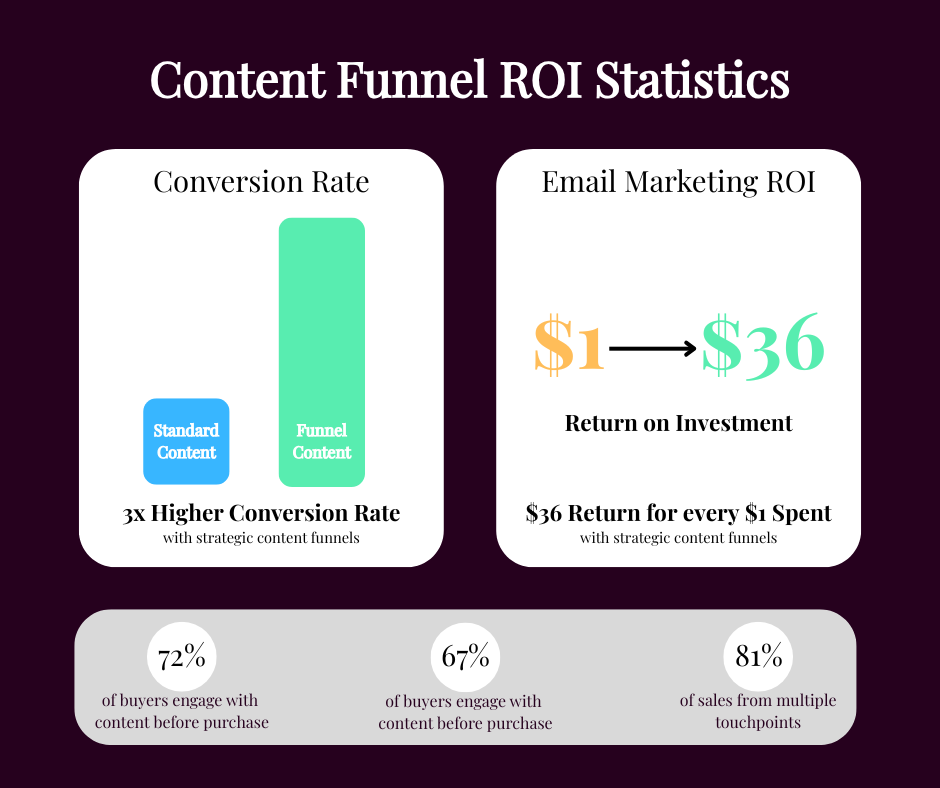
When you pair what you know on social media with newsletters, you’re developing a funnel that promises helpful tips while guiding customers gently toward services. That funnel will take you from an average of $2 for every $1 spent on unfocused social media to $36 for every $1 spent when paired with e-mail marketing.
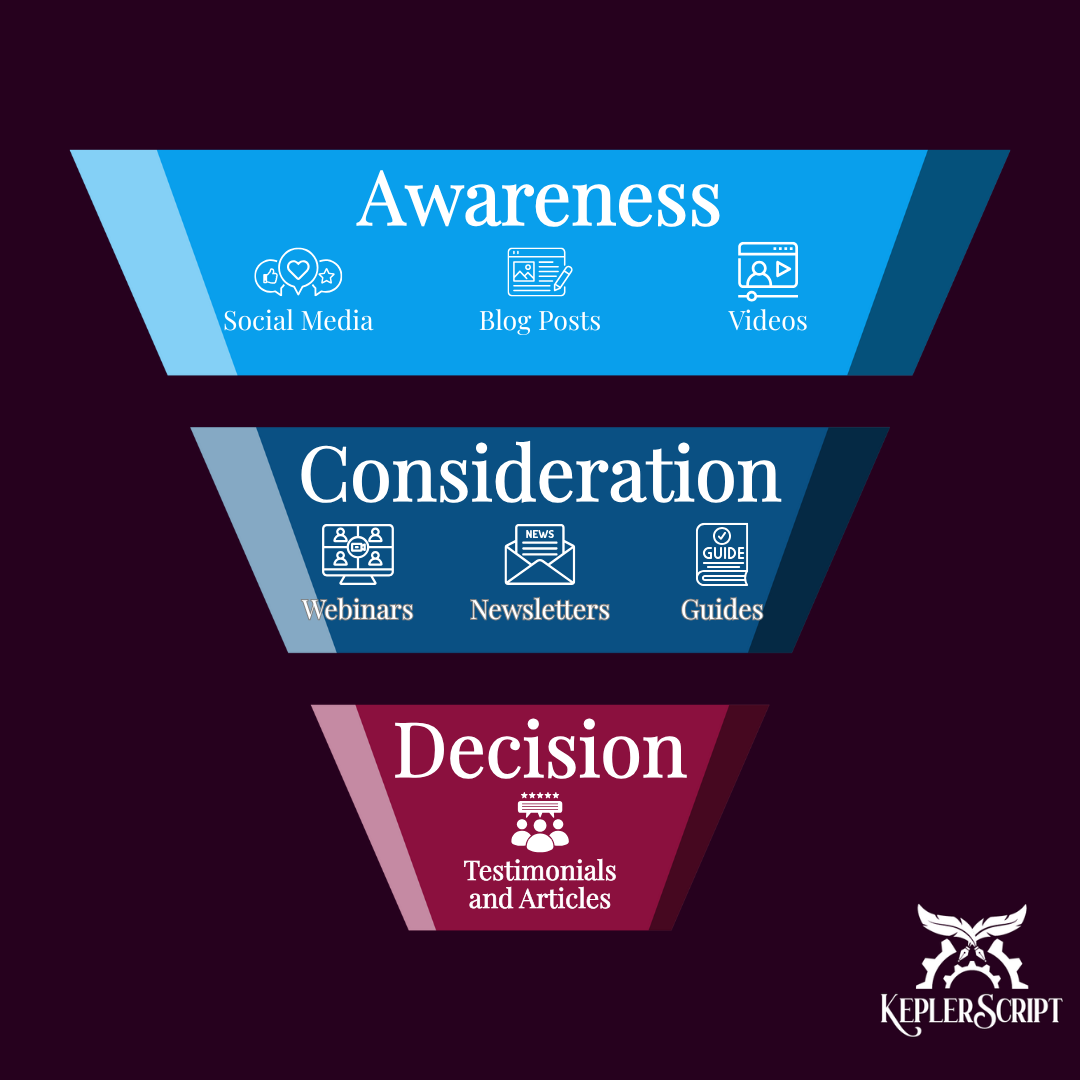
The Three Stages of An Effective Content Funnel
Not all businesses are alike. But, every industry that implements a content funneling system increases in overall ROI.
And each stage looks remarkably similar:
Stage 1: The Awareness Stage
Attracting and identifying potential clients is at the top of content funneling. It prioritizes reach, engagement, and audience growth using some of these vehicles:
- Social media posts directed at key demographics
- Blog posts optimized for search platforms
- Guest articles on industry-respected sites
- Podcast appearances that showcase expertise
These are some of the most effective awareness content strategies for discovery. Whether or not anyone wants to become a client, you’re providing value.
For example, a financial advisor’s awareness content might address retirement planning myths. The information is valuable regardless of who provides it, but your name stays top of mind.
Stage 2: The Consideration Stage
Middle-funnel content focuses on nurturing relationships by overcoming objections about your services or products. Middle-funnel vehicles include:
- Newsletters with actionable insights
- Case studies that demonstrate results
- Webinars that dive deeper into solutions
- Downloadable guides and workbooks that provide frameworks
Middle-funnel content builds trust through consistently delivering value. It provides the solution to specific problems you’ve sneakily referenced yourself.
For example, a business coach might use a newsletter series focused on overcoming growth challenges. The information is valuable on its own, but it provides a natural lead into your coaching program.
Stage 3: The Decision Stage
Conversion is at the bottom of the funnel. Some of the most common content focuses include:
- Service/solution pages that outline specific offerings
- Client success stories that provide social proof
- Testimonials that address common concerns
- Conversion-focused articles that create urgency
You’re reducing decision-making friction by addressing objections and clarifying the next steps for your services, creating compelling reasons to act now.
For example, a healthcare burnout coach might deliver detailed case studies, sharing ROI from previous clients. The content counters objections before they arise in the final decision-making process.
Creating an Effective Content Funnel
Creating your own content funnel means analyzing success stories. Find content funnels that work and replicate their strategies. Each effective content funnel has a relatively similar structure. Here’s a guide to help you set up your own.
Step 1: Map Your Client Journey
Before creating content, put yourself in the shoes of your clients. Ask yourself:
- What questions would I have at each stage?
- What information would I need to move forward?
- What objections might prevent my progress?
- What steps do I need to take consecutively?
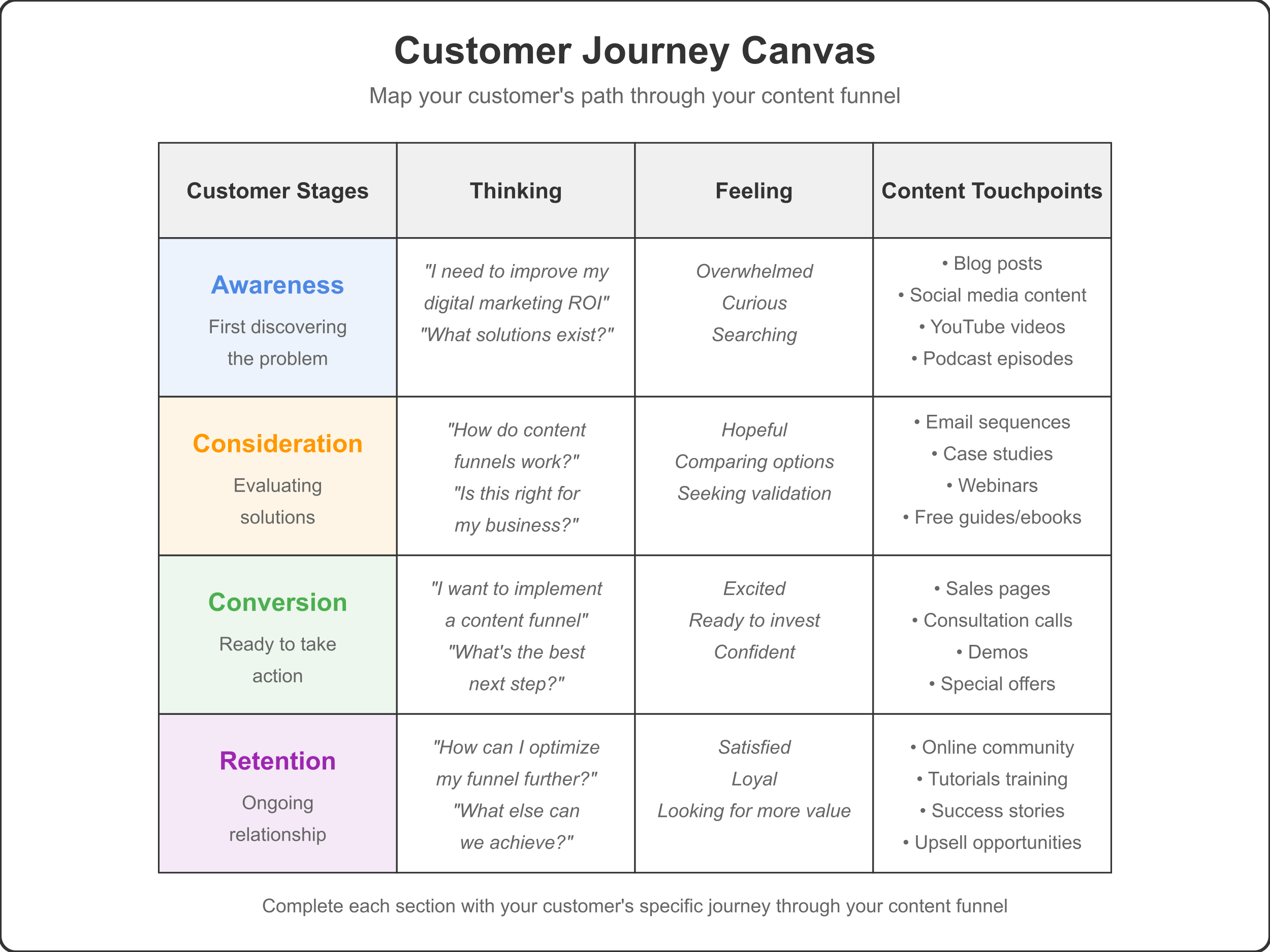
Exercise: Customer Journey Canvas
Create three columns labeled awareness, consideration, and decision. Answer the questions above. Ask yourself which content is needed at each stage instead of generic content.
For example:
Step 2: Audit Your Existing Content
This is where you start critically examining your content. Are you addressing each part of the funnel stage? Are you guiding your prospects to the next step? Or are you simply providing information off the top of your head?
Exercise: Content Funnel Audit
List all content you’ve created in the last 90 days and categorize each piece by the funnel stage. Identify any gaps and evaluate your performance.
Identify any consistent messaging. You might be surprised just how much you’re neglecting in the decision-making stage, the stage that actually converts.
Step 3: Create Content Pathways
Think about this step as the road map. You’re setting up clear pathways for your prospects to follow from discovery to decision.
Exercise: Content Pathway Planning
Design three content pathways by outlining the following:
- Entry point: How do prospects discover you?
- Middle funnel nurturing: How do you build the relationship?
- Conversion point: How do you turn interest into action?
Step 4: Add Content Connections
Connective tissue is most often overlooked. Design a cohesive system instead of isolated components outside your business’s scope.
Exercise: Content Connection Mapping
For each piece of content, identify:
- What content should I put before this?
- What content should come after this?
- How can I create explicit connections between these pieces?
Some of the most effective and simplistic connections include:
- Calls to action that reference the next logical content piece
- Content series with a clear progression
- References to previous content you’ve written to create continuity
- Remarketing old pieces to people who’ve engaged with related content
odule Content settings. You can also style every aspect of this content in the module Design settings and even apply custom CSS to this text in the module Advanced settings.
Step 5: Review And Refine
Once everything’s complete, break out a piece of paper. Your result should look like a schizophrenic’s dream, pieces of string connecting to each other to connect clear pathways.
Of course, the most effective content funnels continually evolve based on your performance data, which makes them more effective over time. Add and subtract, but keep your central theme at the center of your content funnel.

Avoiding Common Content Funnel Mistakes
Your content funnel can go haywire without monitoring. Make your content more efficient by avoiding these mistakes.
Creating Random Content
The more random your content is, even if it’s high quality, the more likely it is to stop prospects in their tracks. Align each piece of your content to a specific purpose within your funnel.
Neglecting Middle Funnel Content
Many businesses prioritize awareness—such as social media—and decision-making content—like sales pages—while overlooking the crucial middle of the funnel. Middle content, like newsletters, fosters relationships and prepares a success track for new prospects.
Missing Connective Tissue
Without clear content pieces, prospects will get lost. Every piece should guide toward a logical next step without losing the plot.
Real World Results
Content funnels aren’t just theoretical. They have real-life applications that have been proven in practice.
In a study from CoSchedule, survey results reported that organized marketers were 674% more likely to show success. The correlation between organization and success has nearly doubled after the COVID-19 pandemic.
A litmus report reported that the most effective marketing tool was e-mail, showing an ROI of $36 for every dollar spent. The test was conducted across multiple industries and company sizes.
Proactively sharing the content from a content library is the most effective in the long run. According to SuperOffice, 95% of buyers choose a company that has provided enough content to navigate through the buying process.
What you’re looking at is a trend of success. Each company generated enough sales because they built a fandom. The people most able to sell their products or services (including books) had one thing in common: A content library.
The Ghostwriter Advantage
Maintaining a sustainable funnel involves three things most busy professionals lack: expertise, time, and consistency.
Professional ghostwriters specializing in comprehensive content libraries provide industry advantages like those listed here:
Strategic Integration
Companies like Kepler Script don’t just write individual pieces. I architect the entire content library to ensure that each of your pieces serves a specific purpose. Each section in the content funnel serves a larger purpose, leading to greater conversion.
Consistent Execution
The most effective content funnels run consistently. At Kepler Script, the weekly package includes
- 10 strategic LinkedIn posts
- 3 targeted newsletters
- 1 conversion-focused article
A consistent strategy builds momentum and keeps prospects moving through your funnel. Hiring the right person eliminates gaps and delays.
Voice Consistency
A team of different marketing members usually means your total consistency suffers. As your dedicated ghostwriter, Kepler Script remains your authentic voice across all platforms, creating a seamless experience for your audience.

Elevating Your Authority
Content funneling is all about building consistent results. The best option for taking your content strategy to the next level is adding a book. You’re creating a powerful authority multiplier that transforms your market position.
The Book Advantage
Producing a professionally ghostwritten book serves multiple purposes in your content funnel:
- Ultimate Top-Level Asset: A book dramatically expands your reach and introduces you to new audiences you might never discover through social media or articles.
- Credibility Accelerator: A book proves organized thoughts, which positions you as a definitive authority in your space; a book can be a key conversion tool in the consideration phase for many prospects.
- Perpetual Lead Generator: Unlike short content pieces, a book generates leads for years when marketed properly.
- Media Magnet: Books that are marketed correctly can open the door to podcasts, speaking engagements, and media appearances that could improve your credibility.
In short, the difference between typical content creators and recognized authorities often comes down to one thing: A book.
Book Ghostwriting Integration with Your Content Funnel
As your ghostwriter, Kepler Script seamlessly connects your existing content funnel to a book by:
- Strategic Topic Selection: Identifying the book concepts that support your business objectives and audience needs.
- Content Repurposing Plan: Developing a strategy to transform your book into content pieces for all funnel stages.
- Lead Capture Integration: Devising a method in which your book strategically guides readers through your content funnel.
- Launch Acceleration: Initiating a comprehensive launch plan that maximizes your book’s impact on your overall content library.
Building Your Content Funnel Today
No matter where you are within your content creation sphere, your conversion rates could always use a boost. A strategic funnel is likely the best answer.
So, the next time you sit down to create content, resist the urge to dive straight into writing. Start off with a plan and analyze where each piece of the puzzle fits in. In the end, your content marketing will go more smoothly, strategically, and successfully.
Remember: Good content marketing doesn’t convert by accident. It revolves around the careful planning and strategic organization found in a superior content funnel.
If you’re ready to transform your random content into a strategic funnel, I’m here to help. Book your Content Funnel Strategy today.
This article gave me exactly the information I was looking for.
The site is a great place to discover thoughtful, informative content.